Golfing Round the World
Chapter IX I Play with Meester Cornelis
Anyone who has ever seen the Bass Rock at the mouth of the Firth of Forth or the bold conical mass of Ailsa Craig in the Firth of Clyde cannot fail to possess an ineffaceable recollection of those startling pinnacular upheavals from the sea. They are magnets to the eye from the moment they come into view until they are lost to sight. To see one is to be inevitably reminded of the other. Again Mont St. Michel, off the Normandy coast, and St. Michael's Mount off Cornwall are two of a kind, striking the same note of emphasis, but each mellowed down by the embellishments of mediaeval architecture.
In a similar manner I cannot forget the bold image of Krakatoa, the Stromboli of the Straits of Sunda. Krakatoa, merely an islet as it is, must be of profound interest to old sailors, for it now but half the size it was three or four decades ago, when, as an extremely active and violent volcano, it blew half its mass into rock splinters and dust, providing specular sunsets for the whole world, and agitating the ocean to such an extent that the wave caused by this great eruption wrecked shipping on the coast of India, near Bombay, three thousand miles away.
It was doubly fascinating for me to see the Straits of Sunda, for I had been thrilled in my schoolboy days, by reading a most vivid and romantic description
of this cataclysmic explosion of Krakatoa in 'Blown to Bits' a capital yarn by R.M. Ballantine. The place bore no semblance to my anticipatory vision.
I had expected to see this
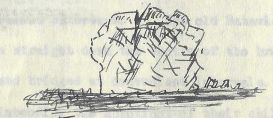
and what I saw was merely that
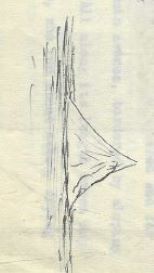
Another illusion gently shattered.
We had only two days to spend in the cheery land of Java, and I was torn by curiosity on the one hand, as to the golf game, and by a desire to see the celebrated botanical gardens at Buitenzorg some fifty miles up country. Curiosity won the day, and I am glad that it did. The latter project was a set and well organised excursion for the tourists and I was fed up with being a tourist: the former was an adventure.
To begin with I did not know a soul in Batavia, again no one on the ship cared a tinker's dam for golf, and at the best I was regarded as a harmless eccentric. Therefore, perforce, I had to pursue my own inquiries. The "Imperatrice" lay alongside the quay in the great docks at Tandjong Priok, which is merely a shipping depot and nothing more. My first requirement was therefore a local map to see where I was. There are few things more fascinating than finding one's own way about in a foreign country and for this a plan is essential.
I made use of the ubiquitous motor car, almost always of American make, and drove along the banks of a shady canal into Batavia, or rather Weltevreden, a distance of eight miles from Tandjong Priok. Weltevreden, which has far out grown its parent city means 'well content' and fully justifies its name. From the picturesque old Dutch port to the furthest limits of the city is a distance of eight miles enclosing a network of canals, broad avenues, and gorgeous gardens surrounding cheerful white bungalows. It is another Colombo, but with the added charm of continuous waterways. The old Batavia River has been canalised and for two miles runs straight down the centre of the broad main avenue, bordered by sloping grass banks, and bridged at convenient intervals. All along its length women may be seen superintending the ablutions of their children, who run about naked, drying themselves in the sun.
I naturally gravitated towards the Hotel des Indes, which is like no other hostelry in the world. Situated in an enormous garden of thirty acres in extent it is really a colony of most attractive bungalows each possessing its own cool loggia, the public rooms occupying a convenient central position, and consisting mainly of a lofty roof supported on white stone pillars and having no visible walls, though presumably screens could be let down for shade and shelter when required.
I took the train into Batavia and sought out the British Consulate for information concerning golf. Instead of treating my enquiry as frivolous, they were more than kind and gave me an introduction to the Batavia golf club at Manggarai. Finding Manggarai was by no means a simple affair. Of course the obvious thing to do would have been to jump into a taxi, gesticulate wildly with my golf clubs, shout Manggarai, and get there. But no, I was in the Far East, and the last thing I ever felt inclined to do was the obvious.
Eventually I took four different kinds of conveyance thus obtaining a leisurely but very thorough view of the life and dwellings of the people, and the beauty of their surroundings. After a short train journey and long drives in steam and electric tramcars I attained to the quaintly named suburb of Meester Cornelis. I hailed a sado, a two wheeled buggy, in which one suits precariously back to the driver. It was some time before I could get en rapport with the jehu, but finally we summoned to our colloquy a dusky passerby, who associated my golf clubs with some place he remembered having seen. At length I was deposited in a lane, opposite a gap in a fence, bordering a field of long grass. I was directed to cross this. Immediately there appeared from nowhere a crowd of brown urchins all yelling at the top of their voices. I soon recognised the breed, for the undisciplined caddie is the same the wide world over. They seized my golf clubs and tore at them and thus in a titanic struggle for their possession we stampeded across the field towards a picturesquely thatched log hut, consisting of a verandah and a bar, which was the club house.
The course of nine holes lay in meadow and marsh land with sufficient undulation to make it interesting. The fairway was very narrow, but like the greens well cared for, and the turf was more like that of an English meadow than any other that I came across in Asia. I enjoyed a delightful round with a Dutch gentleman who had just taken up the game with enthusiasm and was proposing to play it in retirement at The Hague. I have seldom taken part in a more amiable contest.
The flagsticks were longish bamboo poles with hollow basket work balls at the top instead of pieces of bunting. In hot climates one naturally plays in white ducks or Palm Beach clothes, and from the particular suit I was wearing that day I have not been able even now, to eradicate entirely, the thousands of burrs collected on that course. The Japanese burr is easily the most persistently tenacious vegetable in existence; a limpet is its nearest parallel.
Here I met some friendly Americans who showed me the most unobtrusive and thoughtful kindness, helping me with a car lift back to Batavia, and giving me introductions which were to prove very acceptable later on.
Perhaps it was fortunate for me that practically none of my friends aboard ship played golf or at least preferred sight seeing instead; because I was thrown entirely on my own resources and naturally responded to the spontaneous friendly advances of the golfing fraternity wherever I happened to be.
It is apparently a charming custom in the East not only to welcome the bird of passage, but to pass him on to other friends in distant ports. This sense of neighbourly hospitality extends from Bombay to Vancouver and from Batavia to Peking, perhaps even further. We speak of the world as a small place: that is of course a matter of ease of communications and the ubiquitous nature of the British people: but for true compactness and solidarity the Far East might be one parish as far as British, Americans and Europeans generally are concerned. It is some time ago since I dallied with permutations and combinations but I remember they ran into huge figures. Now suppose the ordinary intercourse of mankind is viewed from the mathematical angle, it will be found that almost everybody has a human connecting link with you and with everyone else. You, for instance, are directly acquainted with, say, five hundred other persons, each of whom in turn knows another five hundred. Now combine and multiply and permutate these relationships and possibly you may claim a nodding acquaintanceship with half a million individuals. In fact of course the average man's circle is far greater than a mere five hundred persons, be he pitboy or mining magnate.
And this philosophical and philanthropical reflection is neither idle nor frivolous. Whether it be through the medium of trade or of sport, the more the people of the world know each other, the better it is for the world.
I do not pretend to an exhaustive knowledge of Java after a sojourn of two days, but the fleeting impression made on my mind was one of buoyant cheerfulness and widespread prosperity. The former was undoubtedly due to the continuous brilliant sunshine which displayed the leafy waterways, the summery buildings and gardens and the clean-limbed populace at their best: While the latter owed its prevalence to the rapid development of cultivation of sugar, rubber, tea and a host of other necessities. Java is the size of England without Wales and has a population of thirtyfive millions.
A friend of mine chartered a very superior six cylinder car to drive to Buitenzorg, a beautiful hill station near Batavia which is said to possess the finest botanical gardens in the world. He struck a bargain with a somewhat 'down at elbows' looking Chinaman dressed in blue dungarees, which is the ordinary garb for Chinese coolies in those parts. It was arranged that the car should come to the quayside the following morning. In due course my friend and his party set out on their drive and were mildly annoyed to see that the Chinaman had come out with the car in addition to the smart looking and very expert chauffeur in uniform. However, they supposed he was merely getting a lift back to Weltevreden and bore the intrusion philosophically. But when it was evident that the unwelcome celestial proposed to accompany them all the way, occupying the desirable front seat, they expostulated gently but firmly: Whereupon the Chinese gentleman, all smiles and geniality explained politely to them, that the car belonged to him and that all was 'vellee well'. Things, and Chinamen especially, are not always what they seem.
I shall remember Batavia for two or three little incidents. It was there I learnt a few words of Malay which proved remunerative to me to the extent of at least four florins. I wanted a taxi back to the ship, so I hailed a Buick and, knowing the language I said "Harga berapa Tandjong Prick" (How much to Tandjong Prick). Pat came the reply "Ampat" (four) "Done" said I, very pleased, for the usual tariff for tourists and foreigners was eight florins.
Incidentally a superficial study of Malay would illuminate the somewhat dull and often painful reading of the Stock Exchange List of Rubber Quotations. To know that your pet company with the jaw breaking name really meant "The little rivulet in the green shady hollow" would alleviate the disgust you felt at its having dropped 5/8 - 7/8 during the night.
At mid-day I happened to be strolling about, like a mad Englishman, in the sun, in the square in front of the old Court House in Batavia, when my eye was caught by a seeming absurdity. A very fat little pony, drawing a buggy, was trotting briskly along and vertically beneath his adipose little body, his equally rotund shadow danced about on the almost brilliantly white glaring pavement. I cannot think why my attention should have been attracted by such a triviality, but I now realise that on the Equator every man is his own sundial and he has only to wait till midday, then stand perfectly still and upright in the sun: and if he finds he has lost his shadow, he will know it is noon by real summertime and can set his watch accordingly.
Here also in Weltevreden I first tasted a mangosteen, the much belauded tropical fruit. It would be faintly reminiscent of a creamy peach, if there were such a thing: but it is not nearly so convenient to eat and moreover contains so much that cannot be eaten, that on the whole it is a disappointment. I came to the conclusion that there is none among the tropical varieties to compare with good old English Garden fruits for lusciousness and flavour and that the hot-house peach, muscatel grapes and the William pear stand unrivalled and unchallenged on this planet.